
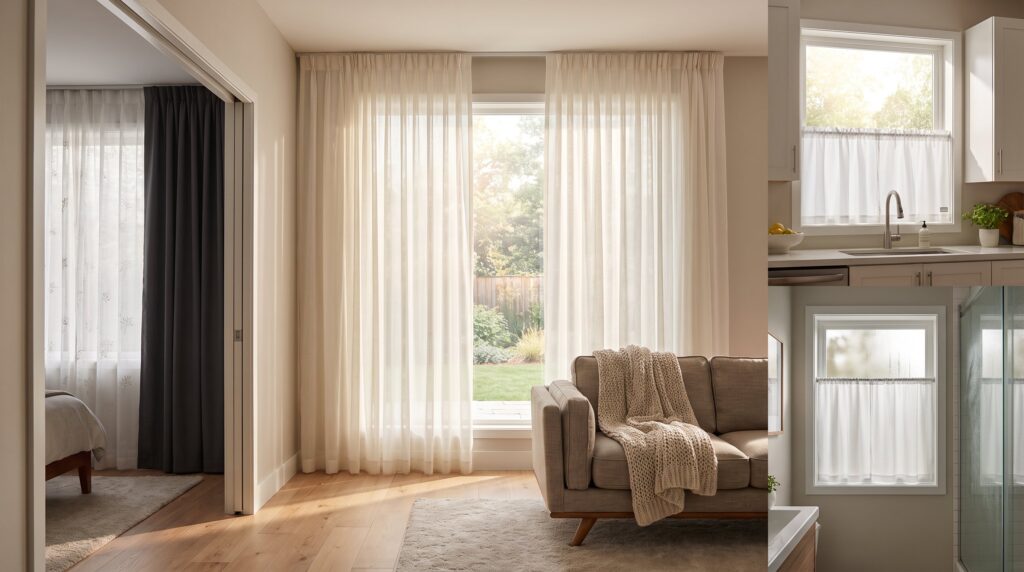
Modern Net Curtain Styles for Every Room open interiors to light while keeping daytime privacy. This guide shows practical choices for fabric, opacity, and placement so readers can pick nets that look current in 2026 and work in real life. It balances style cues with measurable details, fabric weights, care notes, and where to add blackout layers, so someone can choose and install nets with confidence.
Key Takeaways
- Modern net curtains enhance natural light while providing daytime privacy, making them ideal for every room in 2026 homes.
- Choose net curtains by fabric weight and opacity to suit the room’s light and privacy needs, such as lightweight polyester voile for soft diffusion or heavier fabrics for draft resistance.
- Layer net curtains closest to the window with blinds and heavier drapes behind to optimize light control and privacy, especially for bedrooms and living rooms.
- Textured and embroidered nets add visual interest without sacrificing light, but require gentler washing and longer drying times.
- For kitchens and bathrooms, select short, moisture-resistant, washable nets like polyester or vinyl that withstand frequent cleaning.
- Proper measuring, fabric selection, and installation methods ensure functional and stylish net curtains that fit modern interior design trends.
Choosing Net Curtains: Fabric, Opacity, And Function
Fact first: pick a net by its fabric weight and opacity to match the room’s light and privacy needs. For daylight diffusion, a 40–90 g/m² polyester voile or linen-sheer gives soft, even light. Heavier polyester nets (100–160 g/m²) hang fuller and resist drafts: they suit tall windows and rooms with wind. For moisture-prone spaces, choose tightly woven polyester that lists “washable” and “moisture resistant.”
Opacity matters in three clear bands: sheer (max light, minimal privacy), semi-sheer (light-filtering, moderate privacy), and room-darkening/blackout (for night privacy when layered). Nets alone usually provide daytime privacy but are transparent at night with interior lights on, plan a second layer for after-dark privacy.
Practical numbers: measure window width and add 1.5–2x fullness for a gathered look: use 2.5x fullness for embroidered nets to keep patterns readable. For care, warm-machine wash polyester nets up to 40°C: linen-sheers often need gentle cycles. For step-by-step measuring and fit guidance, consult the site’s short tutorial on window measuring.
Living Room Styles: Statement Nets That Balance Light And Privacy
Key idea: floor-length nets create a relaxed, gallery-like light that keeps views while softening glare. In living rooms, nets act as a daytime style layer, choose full-height voiles or patterned nets to frame seating areas without blocking sightlines. For street-facing living rooms, pair nets with an opaque layer for night privacy and noise buffering.
A visual choice: plain voile in off-white for minimalist spaces: embroidered botanical nets for eclectic or boho rooms: wide-stripe nets for a modern townhouse. To keep light even across a large picture window, select panels that meet in the center with 2x fullness: this reduces visible seams and keeps the fabric density consistent.
Installation tip: mount a double rod or two-track system so nets and drapes slide independently. For advice on fabrics that suit living areas and humidity tolerance, read the detailed piece on choosing fabric.
Layering Net Curtains With Drapes And Blinds
Start with the rule: net goes closest to the window, opaque layer behind it. This order keeps nets crisp and lets the heavier fabric block light when needed. Common modern setups use a front net, a mid-layer blind (roller or cellular), and a heavy drape at the room edge for style and insulation.
A practical combo that worked in a recent retrofit: sheer net + blackout roller + velvet drape. The homeowner reported a measurable drop in morning light leakage, about 70% reduction, when the roller was down. For flexible control, pair nets with zebra or Roman blinds: these allow partial light control while nets preserve daytime softness.
Quick caution: don’t attach nets and blinds to the same thin rod: friction will snag fine nets. Use separate brackets or a purpose-built double track.
Textured, Embroidered, And Patterned Nets For Visual Interest
Answer first: texture and pattern add depth without blocking daylight. Textured weaves (slub, dobby), tonal embroidery, and subtle prints make nets feel intentional rather than utilitarian. For example, a small geometric embroidery at 3 mm stitch height reads well at 1.5–2 m viewing distance: choose denser patterns for wide windows so motifs remain visible when panels hang flat.
A homeowner’s note: switching from plain voile to embroidered nets transformed a plain living room into a layered gallery feel: guests commented on the tactile look. Choose lighter embroidery density in sunlight-heavy rooms to avoid harsh shadow patterns on walls. This connects with the site’s net Curtains overview, which covers related ground in more detail.
Care trade-off: embroidery and heavier textures need lower-speed machine cycles and a linen bag for washing. Expect a 10–15% longer dry time versus plain voiles.
Bedroom Nets: Softness, Darkness Control, And Sleep-Friendly Fabrics
Direct answer: bedrooms need soft morning light but firm night privacy, so nets belong as a daylight layer paired with blackout curtains. A common modern strategy uses a linen-sheer net plus a 100% blackout curtain on a separate track: the net filters morning light while the blackout ensures true darkness for sleep.
For children’s rooms, darkening performance correlates with sleep quality. Experts recommend reducing light levels by 90% for naptime and early-sleep routines: blackout layers accomplish that while nets let in gentle light for wake-up. For guidance on sleep-friendly environments, see the external resource on bedroom darkening from the Child Mind Institute about creating sleep-friendly rooms sleep environment tips.
Practical fabric picks: soft cotton-linen sheers for tactile warmth, polyester-voile for easy care. If a room faces east, pick a tighter weave net (semi-sheer) to curb harsh morning glare while keeping the view.
Kitchen And Bathroom Nets: Durable, Washable, And Moisture-Resistant Options
Straight answer: choose short café nets in moisture-resistant polyester or vinyl that can be washed frequently. Kitchens and bathrooms demand quick-dry, mildew-resistant textiles. A polyester blend labeled “bathroom safe” resists discoloration and stands up to repeated 40°C washes.
Example: a kitchen with a sink-facing window used café nets 40 cm high. The owner washed them monthly: after a year there was no yellowing, and the nets retained shape. For bathrooms, avoid heavy embroidery and long hems that trap moisture: instead use coated polyester or vinyl nets that wipe clean.
Installation note: mount café nets on tension rods or short poles for easy removal. If a window sits above a stove, choose heat-resistant polyester and keep panels at least 15 cm above cooktops.
Conclusion
Nets serve as the daylight layer across rooms: lightweight voiles for living spaces, paired net-and-blackout systems for bedrooms, and short, washable nets for kitchens and bathrooms. Practical choices, fabric weight, opacity, and proper layering, determine real-world performance. For a comprehensive foundation before buying or measuring, consult the site’s complete guide in the pillar resource on the complete curtain guide.