
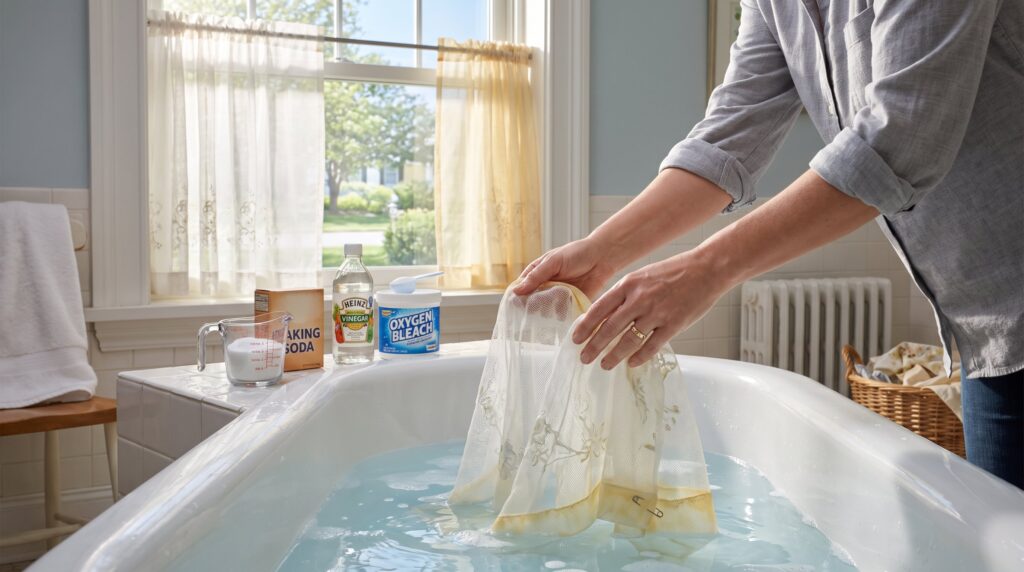
How to whiten net curtains that have yellowed is a common search for homeowners who want bright, airy windows again. This guide gives clear, step-by-step whitening methods that actually work, using gentle household ingredients and safer commercial products. It explains why net curtains yellow, how to inspect and prepare them, several soaking and washing techniques, and how to dry and prevent future discoloration. The instructions assume a typical polyester or nylon sheer but note when delicate lace or vintage nets need extra care. Readers will find practical warnings, realistic expectations, and links to deeper net-curtain resources.
Key Takeaways
- Yellowing of net curtains is caused by accumulated grime and oxidation, not permanent fabric damage, so whitening is often possible.
- Prepare curtains by inspecting for damage, dusting, and pre-treating stains to maximize whitening success and avoid harm.
- Start whitening yellowed net curtains with mild soaks using baking soda and vinegar before progressing to oxygen-based bleach or borax for tougher stains.
- Avoid chlorine bleach unless the care label explicitly permits it, as it can damage delicate polyester, nylon, or lace fabrics.
- Dry net curtains gently by air-drying in shaded, breezy areas and use low-heat ironing or steaming to prevent fiber damage.
- Prevent future yellowing through regular vacuuming, avoiding indoor smoke and kitchen heat, and rotating curtains exposed to sunlight.
Why Net Curtains Yellow: Causes And When To Save Them
Fact first: net curtains yellow because particles and chemical changes build up in the fabric over years, not usually because the fabric itself has permanently gone bad. Dust, airborne grime, cooking smoke, and nicotine deposit on fibres and slowly oxidize, producing a yellow cast. Heat from radiators or direct sunlight accelerates oxidation and makes stains set. In some cases, old chlorine bleach or improper storage causes uneven yellowing or brownish patches.
When to save them: if the lace or net still feels flexible and has no brittle tears, it is usually worth restoring. If threads break when handled or the fabric has a greasy film that won’t lift with soap, replacement may be safer. For guidance on fabric types and care labels, consult the site’s primer on how to measure a window and fabric selection: for example, use the short guide to measure a window before deciding on replacement panels. That helps readers weigh restoration versus new buys.
Quick Prep: Inspecting, Dusting, And Preparing Curtains For Whitening
Answer up front: thorough prep increases whitening success and prevents damage. Start by removing curtains and reading the care label. Lay the curtains flat on a clean surface and inspect for fragile seams, loose embroidery, or tears. Spot fragile areas with safety pins or stitch them temporarily if planning a long soak.
Remove loose dirt and dust by shaking the panels outside, then vacuum gently with a brush attachment. For very fragile nets, hold the fabric in one hand while using low suction and a soft brush. Pre-treat obvious stains by dabbing a paste of baking soda and water for 20–30 minutes: do not scrub lace.
Check fiber content: polyester and nylon tolerate gentler chemical brighteners and warm water: delicate cotton or antique lace needs cooler water and minimal agitation. For a broader plan about curtain care and replacement options, readers can refer to the broader resource on net curtains with practical background in the complete guide.
Methods To Whiten Yellowed Net Curtains Safely
Top-line answer: start with mild, non-chlorine methods (baking soda and vinegar), then use oxygen-based bleach or borax mixtures only when needed. Avoid chlorine bleach unless the care label explicitly allows it and the fabric is robust.
Baking Soda, Vinegar, And Cold-Water Soaks (Step-By-Step)
Start with a test patch: submerge a small corner of the curtain in the chosen solution and watch for color or fibre change for 10–15 minutes. For a full soak, fill a tub with cool-to-lukewarm water (about 20–30°C). Add 1 cup (240 g) of baking soda per 10 liters of water and stir until dissolved. Fully submerge the curtains, gently pressing to remove air pockets. Soak for 2–6 hours: for stubborn yellowing extend to overnight but check every few hours.
After the baking-soda soak, drain and rinse twice with clean water. For vinegar, mix 1 part white vinegar to 4 parts water and soak for 30–90 minutes: vinegar helps cut residue and brightens without harsh chemicals. Rinse thoroughly, then wash on a delicate cycle or hand-wash with mild detergent. Use cold water if the care label warns against heat. These methods remove grime and neutralize acid residues that cause yellowing.
Oxygen-Based Bleach, Borax, And Sun-Brightening (Stronger Safe Options)
If mild soaks fail, use sodium percarbonate (oxygen bleach). Dissolve oxygen bleach according to package directions in warm water (not hot) and soak for 3–6 hours. Sodium percarbonate releases hydrogen peroxide safely and lifts organic stains without the fibre damage associated with chlorine. For heavy stains, combine 1/2 cup borax with the oxygen bleach solution to increase alkalinity and cleaning power: dissolve borax fully before adding fabric.
After any strong soak, rinse thoroughly and wash on a gentle cycle. Sun-brightening helps: hang damp curtains in indirect sunlight for several hours: direct intense sun can heat fibers unevenly, so choose a breezy morning or late afternoon spot. Note the trade-offs: extended sun exposure will brighten but can also weaken delicate fibres over time.
Drying, Ironing, And Preventing Future Yellowing
Direct fact: air-dry net curtains flat or on the line, then use low-heat ironing if needed. After washing and rinsing, gently squeeze out excess water, do not wring. Hang on a line so gravity helps release wrinkles: for lace, drape over a padded rail to avoid stretching. Choose a shaded, breezy spot for faster, gentler drying: bright midday sun for long periods can fade fibres.
If ironing is required, set the iron to the lowest synthetic or silk setting and use a pressing cloth between the iron and the net. Steam from a distance can remove small creases without direct contact. For stubborn creases, hang the curtain damp in a steamy bathroom for 20–30 minutes.
Prevent future yellowing with routine housekeeping: vacuum every three months with a soft brush head, avoid smoking indoors, and keep curtains away from kitchen heat. Rotate panels seasonally if one window receives more sunlight. For readers buying replacement fabric, a short primer explains choices and care: see the article on how to choose fabric for fabric-specific prevention tips.
Conclusion
Restoration is usually possible: gentle soaks with baking soda and vinegar often reverse years of grime, and oxygen bleach or borax mixtures work for tougher yellowing. Always test first, preserve delicate seams, and dry with care. If curtains are brittle or disintegrating, replacement is the safest route. For a fuller overview of curtain selection, maintenance, and replacement options, consult the site’s broader primer on measuring and care resources to choose wisely.