
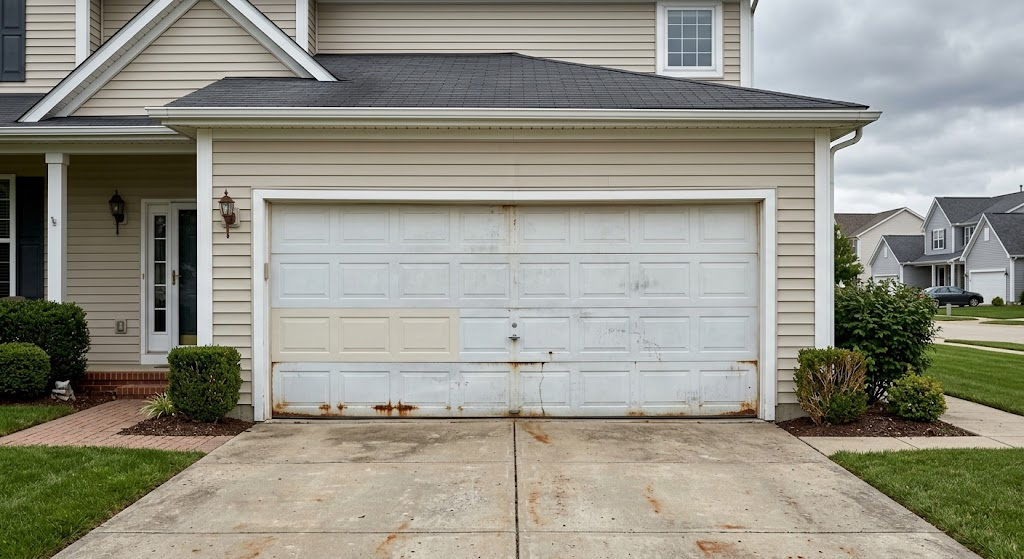
Every garage door reaches a point where the next repair stops being obviously worth it. The trouble is that the point is rarely announced. It arrives as a series of individually reasonable repairs, each one justified on its own, until someone adds up four years of invoices and realizes they have paid for most of a new door in installments.
Here is a framework for making that call properly.
Start With What Has Failed
Some faults are clearly repairs. Some are clearly replacements. Most of the decision lives in the first group and it is worth knowing where the line sits.
Clear repairs: broken springs, worn or frayed cables, seized rollers, a failed opener, a torn bottom seal, loose hinges, misaligned tracks, a single dented section. All of these are routine component work on an otherwise sound door, and none of them justify replacing the whole assembly.
Clear replacements: sections that have separated or cracked across their width, a door that has bowed permanently, widespread rust that has gone through the skin, a door that has been hit hard enough to distort multiple sections, or a door with no available replacement parts because the manufacturer no longer exists.
That last one catches people out. Doors from defunct manufacturers can be impossible to source matching sections for, which turns a simple panel repair into a full replacement by default.
The Age Question
A well-maintained steel door lasts around 20 to 30 years. Wood doors need more attention and often less time. Openers typically last 10 to 15.
Age alone is not a reason to replace. A 25-year-old door in good condition with sound sections is fine. But age changes the calculation on any given repair, because it tells you how much life the rest of the door has left to justify the spend.
The useful rule of thumb: if a repair costs more than about half of a replacement, and the door is past two-thirds of its expected life, replacement is usually the better use of the money.
The Four Faults That Usually Settle It
Section damage across multiple panels. Individual sections can be replaced, and often should be. But once three or four sections are damaged, the labor and parts approach the cost of a new door and you are left with an old door wearing new parts.
Structural rust. Surface rust is cosmetic and treatable. Rust that has perforated the skin, particularly along the bottom section where water sits, is structural, and it will keep spreading regardless of what is done to the surface.
A door that has been repeatedly off track. Once tracks have been bent and re-straightened, sections have been racked, and hinges have elongated their fixing holes, the assembly no longer runs true and never fully will again.
And insulation, or the absence of it. This is the one that is not a fault at all but often drives the decision. Single-skin uninsulated doors make an attached garage brutal in winter and an oven in summer, and no repair changes that.
What Replacement Actually Buys
If the numbers point toward replacement, it is worth understanding what is different about a current door, because the improvement is larger than people expect.
Insulated construction with a steel skin over a polyurethane or polystyrene core makes a measurable difference to garage temperature, and it makes the door significantly quieter in operation because the sections do not drum.
Modern hardware runs quieter. Nylon rollers with sealed bearings instead of bare steel, better hinges, and better track tolerances add up to a door you cannot hear from a bedroom above the garage.
And the whole assembly is specified together. A garage door replacement means the springs are matched to the actual weight of the new door, the tracks are set to the correct clearance, and the opener force is calibrated to a balanced assembly rather than to whatever the old door had become. That coherence is worth a lot, and it is exactly what gets lost when a door is repaired piecemeal over fifteen years.
Choosing the Replacement
Four decisions matter, in this order.
Insulation value, expressed as an R-value. Higher is better, and it matters most if the garage is attached, heated, or used as a workspace. Uninsulated is only defensible on a detached garage in a mild climate.
Construction. Single-layer steel is the cheapest and the noisiest. Two-layer adds insulation. Three-layer adds a steel back skin, which is significantly more rigid and durable as well as quieter.
Material. Steel is the default for good reason. Aluminum resists corrosion and suits coastal properties. Wood looks best and demands the most upkeep. Fiberglass and composite sit between.
Then style and glazing, which is where most people start and where the least performance is decided.
One Thing to Check Before Deciding Anything
Before comparing quotes, get an honest assessment of the existing door. Some doors that feel finished are actually fine underneath, needing springs, rollers and a bottom seal to run like new. Others that look tidy have structural problems that make further repair a waste.
A technician who is willing to tell you the door is worth repairing is the one whose replacement recommendation is worth believing.