
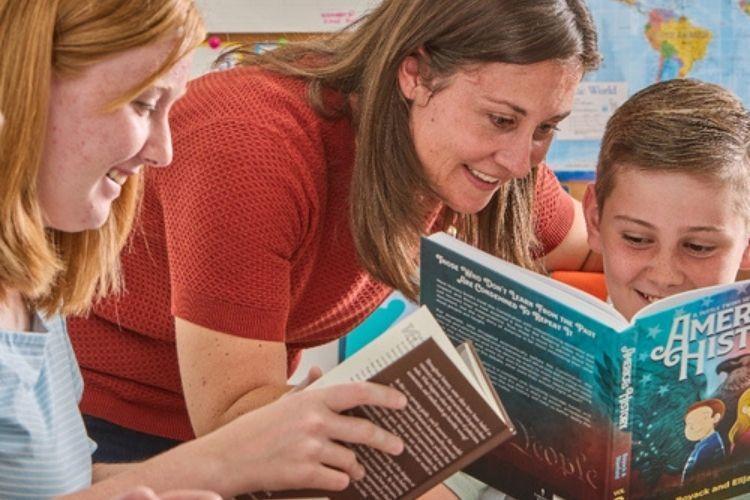
Tuttle Twins has developed since its launch from a small children’s book project into a broad education brand covering economics, civics, American history, financial literacy, entrepreneurship, and critical thinking. Its central proposition is straightforward: ideas usually introduced through adult nonfiction can be recast as illustrated adventures, family discussions, and age-graded activities. That approach places the company within a wider market for parent-directed learning outside formal classrooms. It also gives families a structured way to discuss subjects that many elementary programs address only briefly. The material is openly values-based, with a strong emphasis on liberty, property rights, free markets, individual sovereignty, and personal responsibility. For supporters, that clarity is the attraction. For prospective buyers, it also makes the brand’s viewpoint important to understand before using the books as a primary resource.
From Two Books to a Multi-Age Education Catalog
Author Connor Boyack and illustrator Elijah Stanfield launched the first two Tuttle Twins books in the United States in 2014. Boyack, who founded and leads the Libertas Institute, created the series after finding few children’s books that explained property rights, justice, and market economics. The earliest title drew from Frédéric Bastiat’s The Law, establishing a model the company later repeated with works by Ludwig von Mises, F. A. Hayek, Leonard Read, Henry Hazlitt, and other free-market writers.
The company reports more than seven million copies sold. Background figures provided for this article place its annualized revenue run rate at about $34 million by late 2025 or early 2026. Those numbers indicate that the project has moved beyond a specialist publishing experiment. Its current catalog includes illustrated stories for ages five to twelve, ABC and 123 board books for toddlers, American history volumes, audiobooks, downloadable workbooks, parent guides, teen guidebooks, and choose-your-own-adventure-style titles. Bundles such as the Family Starter Pack, Mega Bundle, and Teen Bundle organize these materials by age and depth.
Storytelling Translates Abstract Ideas Into Family Discussion
The brand’s most distinct product feature is its use of recurring characters, Ethan and Emily Tuttle, to put abstract ideas into recognizable situations. Stories address inflation, sound money, competition, protectionism, government power, entrepreneurship, and personal responsibility through conflicts that children can follow. Instead of asking a young reader to begin with theory, each book introduces a problem, shows consequences, and adds questions for discussion.
Company materials describe story-based lessons as up to 22 times more memorable than isolated facts. Its current website separately cites a 1969 memory study reporting 93 per cent recall for information organized as stories compared with 13 per cent for conventional study. Those figures should not be treated as product-specific proof, but they explain the instructional logic behind the series.
Independent reviewers broadly confirm the format, even when they don’t endorse every conclusion. Cathy Duffy Reviews notes that the books connect stories to source texts and include glossaries plus four to six discussion questions. It also cautions that parents must judge which questions suit a child’s age. Teacher Tutor Mom describes the history books as presenting “grown-up” concepts through narrative, maps, timelines, illustrations, and information boxes. Together, those features support what Tuttle Twins calls the “Dinner Table Moment”: a conversation prompted by shared reading rather than a completed worksheet alone.
Supplemental Materials Serve Public-School and Homeschool Families
Tuttle Twins is often associated with homeschooling, but company audience data shows a broader customer base. The brand says 78 per cent of its families send children to public school. Its leadership expects homeschool customers to remain important while eventually accounting for about 20 per cent of revenue. That positioning makes the books less a replacement for school than a supplemental curriculum for many households.
The preschool and homeschool range at The Tuttle Twins shows how the company adapts one philosophy across developmental stages. Toddlers encounter terms through alphabet and counting books. Elementary-age children receive illustrated narratives, activity workbooks, and parent guides. Teen materials shift toward longer guides, decision-based stories, entrepreneurship, logical fallacies, bias, courage, and historical case studies. Audiobooks and an online academy add formats for families that prefer listening or video lessons.
This layered catalog addresses a practical need in families with several children. One purchase can support a preschooler, an elementary reader, and a teenager without requiring parents to assemble unrelated resources. Company customer data identifies mothers aged 24 to 54 as roughly 78 to 80 per cent of buyers. Grandmothers form a secondary gift-giving group. The typical household has multiple children, which helps explain the emphasis on bundled collections and reusable family materials.
A Clearly Defined Viewpoint Creates Both Focus and Limits
The company’s market position rests on more than format. It serves parents who want financial literacy, civic understanding, entrepreneurial thinking, and skepticism toward institutional messaging. Brand research says 90 per cent of parents lack confidence that schools prepare children for real-world success, while financial literacy ranks as their most requested subject. These are company-cited findings rather than neutral national measures, but they shape product development and messaging.
Tuttle Twins describes its foundation as principled and nonpartisan. Its books do not function as party campaign materials, yet they are not ideologically neutral. They interpret history, economics, and government through a liberty-oriented framework influenced by Austrian economics, the non-aggression principle, free markets, and individual sovereignty. Families may regard that consistency as useful or may pair the series with contrasting sources to broaden discussion.
Sales are strongest across what the brand calls the “Smile of the United States,” including California, Texas, Florida, Georgia, New York, and Pennsylvania. Texas is reported as its second-largest state. That geographic spread, along with the large public-school segment, suggests the audience is defined more by parental priorities than schooling type.
Tuttle Twins occupies an unusual niche: children’s publishing that systematically translates libertarian and Austrian economic ideas into stories, curricula, and family conversation tools. Its concrete benefit is not ideological neutrality, but accessibility and continuity across ages. As parent-led education grows, the brand’s prospects will depend on maintaining readable materials, supporting claims carefully, and giving families enough context to evaluate the ideas presented.